Paper and Pencil, No Fast Travel: The Players Who Draw Their Own Way Through Games
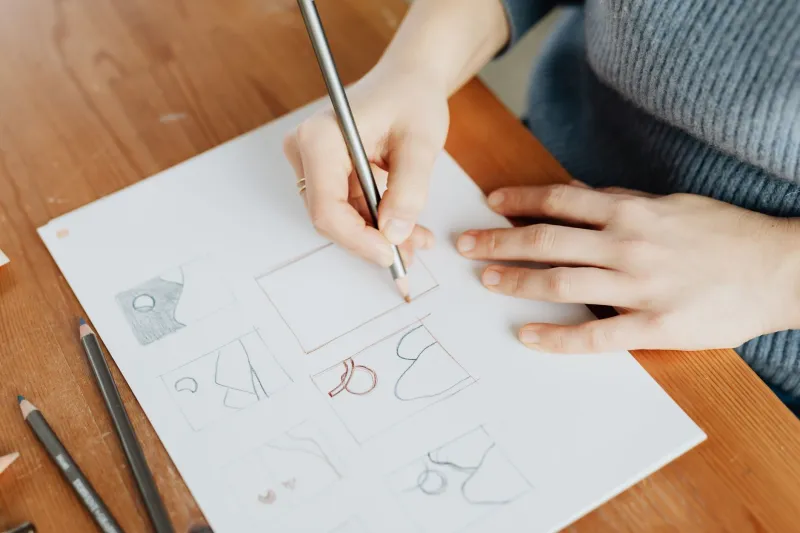
There's a particular kind of quiet that settles over a desk at 11pm when you're three hours into mapping a dungeon that doesn't technically exist. Graph paper. A mechanical pencil. Maybe a second color for doors you haven't opened yet. The game is still running on the TV across the room, paused at a junction you're not ready to commit to until the layout makes sense on the page in front of you.
This isn't a retro quirk or a speedrunner's edge. It's a whole community — loosely organized, deeply passionate, and growing in ways nobody really anticipated — of players who have decided that the act of drawing a game's world by hand is, itself, a form of play worth protecting.
The Grid Paper Revival Nobody Announced
Walk into any dedicated gaming subreddit on a slow Tuesday and you'll find them: photos of hand-inked dungeon layouts from Elden Ring, color-coded overworld grids from Hollow Knight, meticulous room-by-room breakdowns of Outer Wilds sketched in the margins of composition notebooks. The posts rack up engagement fast. Not because the maps are always beautiful — some are genuinely rough — but because they feel earned in a way a screenshot never could.
Marcela Okonkwo, a 32-year-old middle school art teacher in Columbus, Ohio, started mapping games during a particularly bad stretch of pandemic boredom in 2020. She'd grown up watching her older brother chart The Legend of Zelda: A Link to the Past on graph paper in the early nineties. When she picked up Disco Elysium looking for something absorbing, she found herself wanting to track not just locations but emotional beats — which conversations happened where, which decisions she'd made in which rooms.
"I wasn't trying to be nostalgic," she says. "I just realized the in-game journal wasn't capturing what I wanted to remember. So I started drawing it. And then I couldn't stop."
Her maps now fill two binders. She shares them occasionally on Tumblr, where a small but devoted audience follows her work with the intensity usually reserved for serialized fiction.
Why the Minimap Isn't Enough
Most modern games are aggressively helpful. Waypoint markers, fast travel menus, GPS-style minimaps, quest trackers that hold your hand from objective to objective — the infrastructure of navigation has become so robust that getting genuinely lost in a game world is almost a design choice, a feature you have to opt into.
For a certain kind of player, that helpfulness feels like a loss.
Derek Suh, a 29-year-old software developer in Portland, describes it as the difference between being a passenger and being a navigator. "When the game tells you where to go, you're just executing," he says. "When you're making the map yourself, you're constructing the space. You start to understand why the designer put that corridor there, or why this room feels wrong before you can explain it."
Derek has been hand-mapping games since college, when he played through the original Dark Souls with a spiral notebook beside his keyboard. He's since moved on to isometric RPGs, immersive sims, and the occasional sprawling JRPG. His maps are functional rather than decorative — dense with symbols, abbreviations, and margin notes — but he posts them anyway because the response from other players has been consistent and warm.
"People tell me it makes them want to play the game differently," he says. "Not necessarily to map it themselves, but to slow down. To notice more."
Cartography as Meditation
The word that comes up most often in conversations with these players is meditative. There's something about the repetitive physical act — drawing a wall, marking a door, labeling a room — that creates a different relationship with a game's pacing. You can't rush it. You can't tab out to a wiki and cross-reference. You're working from what you know, and the gaps in your map are a record of what you haven't figured out yet.
For Priya Mehta, a 35-year-old UX designer in Chicago, the practice started as a way to manage anxiety. She'd been playing games her whole life but found herself increasingly overwhelmed by open-world titles with hundreds of collectibles and branching systems. "I'd open the map and just freeze," she says. "There was too much."
A therapist suggested she try playing without looking at guides for a week. She picked up Morrowind — a game old enough that its in-game map is notoriously sparse — and started drawing. Within a few sessions, the anxiety had shifted into something she describes as absorption. "You stop thinking about finishing the game. You're just in it."
Priya now hosts a small Discord server called Uncharted Territory where about four hundred players share their hand-drawn maps and discuss methodology. The culture there is deliberately low-pressure. No one grades accuracy. Rough sketches are celebrated as much as careful renderings.
The Art Side of the Equation
Not everyone is keeping their maps in a spiral notebook. A growing subset of this community treats cartography as a genuine artistic practice, producing illustrated maps that sit somewhere between functional document and decorative object.
Jamie Rosenthal, a freelance illustrator based in Austin, Texas, has been creating finished, frameable maps of game worlds for about three years. She works in ink and watercolor, spending anywhere from ten to thirty hours on a single piece. Her map of Stardew Valley's Pelican Town, rendered in the style of an eighteenth-century survey map, sold as a print within hours of posting.
"Games give you a world but they don't give you the feeling of a world," Jamie says. "When I draw it, I'm translating it into something physical. Something that has weight."
She's careful to note that her process still starts with exploration. She doesn't trace screenshots or import coordinates. She plays, she sketches rough layouts, she revises as she discovers new areas. The final illustration is the last step in a process that's fundamentally about paying attention.
The Frequency of Slowness
What makes this community interesting — and genuinely strange, in the best possible sense — is that it's not a reaction against games themselves. These aren't people who think modern games are bad or that the old ways were better. They love the games they're mapping. They're just choosing to experience them at a different frequency.
In a medium that increasingly optimizes for efficiency, for completion percentages and achievement unlocks, the act of sitting down with a piece of paper and drawing what you found feels almost radical. Not because it's difficult, but because it's deliberately, unapologetically slow.
The map doesn't tell you where to go. It tells you where you've been. And for a growing number of players, that distinction is everything.