From Late Fees to Deep Cuts: The Ex-Video Store Clerks Building the Streaming Libraries Money Can't Find

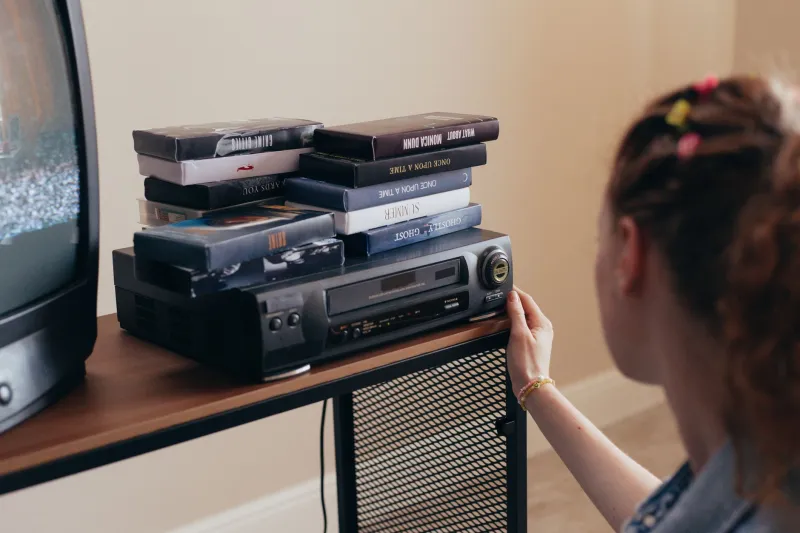
Photo: vintage video rental store shelves VHS tapes, via i.pinimg.com
There's a specific kind of frustration that lives somewhere between Netflix's homepage and your third lap around a Letterboxd list at midnight. You know something good exists. You can almost feel it. But the algorithm keeps handing you the same fifteen movies dressed up in different thumbnails, and you're starting to wonder if "discovery" was always a lie.
Some people got tired of wondering. They went looking for a human instead.
The Clerks Who Never Forgot
For about two decades, the video rental store was America's most underrated cultural institution. Not because of the movies themselves — you could find those anywhere — but because of the people working the floor. These were folks who had seen everything, filed everything, and more importantly, remembered everything. They knew which obscure Hungarian thriller would land for the customer who loved early Cronenberg. They knew which shelf to check when someone came in asking for "something like Twin Peaks but weirder."
When Blockbuster collapsed and Netflix finished the job, that institutional knowledge scattered. Most of it just... evaporated. The clerks moved on to other industries, carrying terabytes of film literacy in their heads with nowhere to put it.
Until recently.
A loosely connected network of former video store employees — some from Blockbuster, some from regional chains, some from the indie shops that always smelled faintly of carpet cleaner and ambition — has quietly turned that expertise into a service. They're building hand-curated streaming libraries. Compiling private recommendation databases. Consulting for collectors who have the budget to license obscure titles but zero idea where to start.
Think of it as the sommelier economy, but for film.
What "Curated" Actually Means
The word gets thrown around so casually now that it's basically meaningless. Every playlist is "curated." Every subscription box is "curated." But spend twenty minutes talking to someone who spent fifteen years categorizing VHS tapes by director's second feature and you start to understand the difference between a human filter and a recommendation engine.
One former assistant manager from a Blockbuster location in suburban Ohio — who asked not to be named, partly out of professional discretion and partly because he finds the whole thing a little funny — described his process like this: "I don't ask people what they liked. I ask them what they almost turned off but didn't. That's where the real taste is."
He now maintains a private database of roughly 4,000 titles, cross-referenced by mood, pacing, cinematography style, and what he calls "tolerance for ambiguity." Wealthy clients — he has about a dozen, mostly in New York and LA — pay a monthly retainer for access to a curated queue that updates based on ongoing conversations. No star ratings. No algorithms. Just annotated lists delivered via a shared Google Doc that reads more like a letter from a trusted friend than a software output.
"The algorithm optimizes for completion," he says. "I optimize for the thing you'll still be thinking about in three weeks."
Underground IMDb, Built on Memory
Not everyone in this loose community is working the high-end consulting angle. Some are building something more communal — private databases that function like shadow versions of IMDb, populated entirely by human annotation.
These aren't public websites. They're shared spreadsheets, Notion pages, and the occasional hand-coded tool that circulates through invite-only channels. Entries include standard metadata, sure, but also notes like "best watched after a breakup," "the third act will make you angry in a productive way," or "this one's for people who think they hate subtitles but actually just hate bad subtitles."
The contrast with mainstream platforms is almost philosophical. Streaming services measure engagement in seconds. These databases measure it in the kind of detail that only comes from someone who once spent a slow Tuesday watching every film in the Criterion Collection's out-of-print catalog just because it was there.
Why Now?
There's something almost ironic about the timing. The same streaming era that made video rental stores obsolete has created the conditions that make these clerks valuable again. When there were 500 movies at your local Blockbuster, a knowledgeable employee was helpful. When there are 50,000 titles on a single platform and the discovery interface is designed primarily to keep you subscribed rather than satisfied, that same employee becomes something closer to essential.
A few of the people operating in this space have started talking to each other more formally — sharing methodology, comparing databases, occasionally collaborating on themed collections for clients who want something specific. There's no organization, no name, no website. Just a Slack channel someone set up a couple years ago that's grown to about eighty members.
"We're not trying to be a business," says one participant, a former Hollywood Video shift supervisor who now lives in Portland. "We're just people who never stopped thinking about movies the way most people stopped thinking about movies when streaming made it feel like homework."
The Frequency Nobody's Broadcasting
What makes this whole thing feel distinctly Nirgilis-coded is how deliberately it operates outside the visible spectrum. No app. No press release. No influencer partnerships. Just people with deep, weird, specific knowledge finding other people who actually want it — and building something that works precisely because it refuses to scale.
The algorithm will never replicate what these clerks carry around in their heads, not because the technology isn't capable, but because the knowledge was built through a fundamentally different process. It came from boredom and curiosity and thousands of hours of watching things nobody asked them to watch. It came from conversations with strangers who were just trying to pick something for a Friday night and ended up in a forty-minute discussion about the decline of mid-budget American cinema.
You can't train a model on that. You can only find the person who lived it.
And if you know where to look — or more accurately, if you know someone who knows someone — you might just get a Google Doc link and a note that says: Start with the third one on the list. Trust me.