Dead Air Cartographers: The Obsessives Mapping Every Radio Frequency the World Forgot
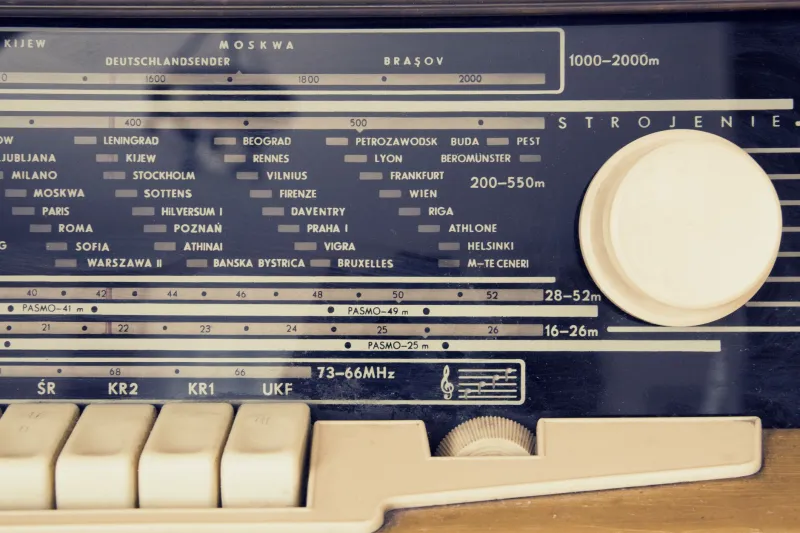
There's a number that keeps coming up in conversations with this particular corner of the internet: 88.1. It's a frequency that means almost nothing to most people — maybe a college station, maybe static, maybe a faint gospel signal bleeding in from two counties over. But to the people who spend their evenings cross-referencing FCC databases against handwritten listener logs from the 1990s, 88.1 is a coordinate. A location on an invisible map. And invisible maps, it turns out, have a surprisingly passionate cartography community.
Meet the frequency hoarders.
They don't love that name, for the record. But it's the one that's stuck inside the forums and Discord channels where this subculture lives. The more generous framing is that they're radio historians, or broadcast archaeologists, or — as one particularly poetic member of the community put it in a post that got screenshot and passed around for weeks — "the people keeping the dial honest."
What They're Actually Building
The project, if you can call it that, is decentralized by nature. There's no single organization, no nonprofit with a grant, no university backing. What exists instead is a constellation of community-maintained spreadsheets, wikis, and custom databases that collectively attempt to document every radio frequency that has ever carried a signal — active, dormant, or dead.
That means the 10-watt pirate station that ran out of a garage in South Florida for eight months in 1994. The Indigenous community broadcaster in New Mexico that lost its license in a paperwork dispute and never came back. The AM gospel station in Mississippi that went dark when the owner died and the family couldn't figure out what to do with the tower. All of it. Every ghost frequency, catalogued.
The tools vary by contributor. Some use custom-built web scrapers that pull from FCC public records and flag discrepancies with historical logs. Others rely on something closer to oral history — reaching out to former DJs, station managers, and longtime listeners to fill gaps that official documentation never captured. A few members specialize entirely in pre-digital records, scanning physical program guides and local newspaper radio listings from the 1960s through the 1980s to reconstruct what was broadcasting before any of it was digitized.
"The FCC database is useful but it's not the whole story," explained one contributor who goes by the handle Terrestrial_Ghost and has been at this for about six years. "It tells you what was licensed. It doesn't tell you what was loved. Those are two very different archives."
The Flex Nobody Expected
Here's where it gets genuinely weird, in the best possible way. Inside these communities, knowing obscure frequency history has become a form of cultural currency. Not in a gatekeeping, gatekeeping way — the vibe skews collaborative rather than competitive — but in the sense that surfacing a truly forgotten station carries real social weight.
Posting documentation of a defunct bilingual station that served Chicago's Puerto Rican community in the early 1980s will get you more respect in these circles than almost anything else you could contribute. Ditto for tracking down a recording — even a partial one — of a broadcast from a station that officially has no surviving audio. The rarer the find, the more it circulates.
There's also a geographic dimension that's become its own rabbit hole. Members have started building what they call "broadcast density maps" — visual overlays that show, decade by decade, how the radio landscape of specific regions changed over time. Watch a map of the American South between 1950 and 1980 and you can literally see the growth and contraction of Black-owned stations as the economic and political climate shifted. Watch the Pacific Northwest in the 1990s and you can track the explosion of alternative and community radio that mirrored the music scene happening in the same zip codes.
"It becomes a different kind of history when you see it geographically," said one member who focuses on mapping the Midwest. "You stop thinking about individual stations and start thinking about who had access to a microphone and when. That's a story worth telling."
Where Official Records Fall Short
The FCC, to its credit, maintains public records. But those records have significant gaps, particularly for low-power stations, tribal broadcasters, and anything that operated in a gray area before stricter licensing enforcement. Pre-1980s documentation is especially patchy. And for pirate or unlicensed operations — which represent a surprisingly large chunk of broadcast history, especially in urban communities that felt underserved by mainstream radio — there's essentially nothing official at all.
This is where the community fills in. Members have developed their own verification standards, borrowing loosely from archival and journalistic practice. A frequency listing needs at least two independent sources before it gets added to the main database. Audio recordings, when they exist, are uploaded to a shared repository with metadata tagging. Physical artifacts — old QSL cards, station bumper stickers, program schedules — get photographed and catalogued.
It's not perfect. There are disputes. There are errors. There are occasional flame wars over whether a particular station qualifies as "defunct" versus "temporarily dark." But the overall quality of the archive has grown steadily, and several members have been approached by academics and documentary filmmakers who found the database more comprehensive than anything available through institutional channels.
Why It Matters Beyond the Hobby
It's easy to look at this and see pure nostalgia — people who love old radio doing a very detailed version of what people who love old radio do. And sure, that's part of it. There's genuine warmth in these communities for the medium itself, for the particular texture of over-the-air broadcasting that streaming has never quite replicated.
But there's something else running underneath it. These frequency maps are, in a very literal sense, maps of who got to speak and who got heard. Radio frequencies were — and in many places still are — scarce public resources. Who controlled them, when, and for how long is a question with real political and cultural weight. Knowing that a particular community had a voice on the dial for a decade before losing it isn't trivia. It's evidence.
The frequency hoarders aren't making that argument loudly. Most of them would probably deflect if you called their hobby activism. But the archive they're building is quietly political in the way that all serious preservation work is political: it insists that things matter enough to remember.
And somewhere out there, 91.3 FM is waiting to be found.