Born After Napster, Obsessed With Tape: The Gen Z Kids Who Chose Static Over Spotify
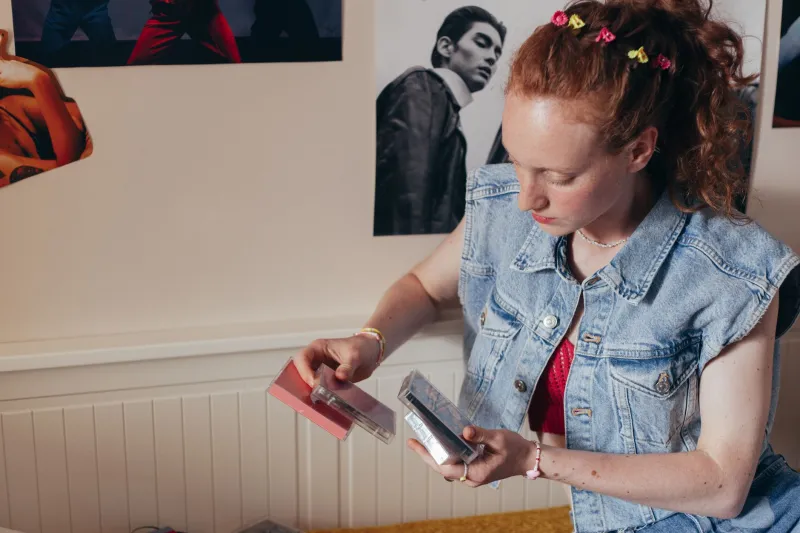
There's a kid in Columbus, Ohio who has never owned a CD. She was born in 2006, grew up on YouTube autoplay, and has had a Spotify account since she was twelve. She also has a shoebox under her bed containing forty-three cassette tapes, a Walkman she bought for eight dollars at a Goodwill, and a dual-deck dubber she uses to copy tapes for her friends at school. She charges three dollars a copy. She's not doing it for the money.
"Streaming feels like renting air," she told me over Discord. "Tapes feel like you actually have something."
This is happening more than you'd think.
The Numbers Don't Lie, Even If They're Weird
Cassette sales in the US have been climbing for several consecutive years now, and the demographic driving that climb isn't the forty-something who remembers making mixtapes in 1994. According to data from the Recording Industry Association of America and various independent label surveys, a significant and growing slice of tape buyers are under twenty-five. Some are under eighteen. These are people for whom a cassette player is not a relic from their own past — it's a piece of technology they discovered the way previous generations discovered shortwave radio or CB handles. Deliberately. Curiously. A little defiantly.
The numbers are still small in the grand scheme of music consumption. But the energy behind them is disproportionately loud.
What Streaming Actually Took Away
To understand why teenagers are reaching for something their parents threw out, you have to understand what they feel is missing from the dominant listening experience they were handed at birth.
Streaming is frictionless. That's its entire selling point. You think of a song, it plays. You don't own it, you don't hold it, you don't wait for it. The algorithm anticipates you before you've finished a thought. For a certain kind of music listener — and there are a lot of them — that frictionlessness starts to feel like a problem after a while. Not a bug, exactly. More like an absence.
Cassette tapes reintroduce friction at every level. You have to find them, buy them, handle them, flip them. The sound degrades in ways that are specific to your copy, your deck, your tape head. Two people listening to the same album on the same cassette release will have subtly different experiences depending on how worn their players are, how many times they've rewound. There's hiss. There's wow and flutter — that gentle pitch wavering that audiophiles hate and tape people have learned to love. The music becomes physical in a way that a streaming queue simply cannot replicate.
"It's like the difference between a text and a letter," one seventeen-year-old tape collector from Portland put it. "They contain the same words but they don't feel the same."
The Underground Duplication Scene
What makes the current cassette moment genuinely interesting — and genuinely weird — is that it hasn't just produced a bunch of kids buying official label releases at Urban Outfitters. It's spawned a parallel infrastructure of DIY tape labels, home dubbing networks, and underground distro chains that operate mostly through Discord servers, Instagram DMs, and small Bandcamp storefronts.
These micro-labels are putting out runs of fifty, sometimes twenty-five tapes. Hand-dubbed on consumer equipment. J-cards printed on home inkjets, sometimes hand-stamped or drawn. They're releasing music that will never see a streaming platform — not because the artists can't get on one, but because they've specifically chosen not to. The tape is the only version. If you don't have the tape, you don't have the music.
This scarcity is intentional, and it cuts against everything the streaming era was built on. The whole promise of digital music was infinite availability. These kids are betting on the opposite.
Some of these labels are run by teenagers. There are sixteen-year-olds in the Midwest managing small rosters of bedroom pop and lo-fi punk acts, handling fulfillment out of their bedrooms, learning what a consignment deal is because a local record shop agreed to carry five copies. The learning curve is steep and the margins are basically nonexistent. Nobody seems to care.
Degradation as Philosophy
Here's the part that takes some sitting with: the tape kids aren't tolerating the limitations of the format. They're philosophically committed to them.
Tape degrades. Every copy is a little worse than the source. Every play wears the oxide layer down a fraction more. The sound that comes out of a well-loved cassette is not the same as the sound that went in, and everyone involved knows this. In a music culture that has spent thirty years chasing higher fidelity — CD over vinyl over MP3 over FLAC over hi-res streaming — choosing a format that actively deteriorates is a statement.
"I like that it changes," one collector explained. "My copy of this album is slowly becoming my copy. Not the band's copy. Mine."
This is a genuinely different relationship to recorded music than anything streaming offers. Spotify doesn't change based on how many times you've listened. The file is the file. The tape is a living object, in a weird, entropic sort of way.
There's a philosophy here that rhymes with certain strands of art and punk and DIY culture, but it's being arrived at fresh by people who didn't inherit it. They found their way to it through frustration with recommendation engines and infinite scroll and the feeling that music had become wallpaper.
The Format Is the Message
It would be easy to dismiss all of this as aesthetic posturing — kids doing a retro thing because retro things cycle back around. And sure, some of it is that. The Walkman-as-fashion-accessory is real. There are TikTok accounts dedicated entirely to tape deck aesthetics that have nothing to do with actually listening to music.
But the more you talk to the people who are actually dubbing tapes in their bedrooms at midnight, who are running tiny labels out of their college dorm rooms, who are trading tapes at shows the way people used to trade demo CDs — the more it becomes clear that something more considered is going on.
They're not trying to recreate 1987. They weren't alive in 1987. They're using an old format to solve a new problem: how do you have a relationship with music when music has been made into a utility?
The tape is their answer. It's inconvenient, degradable, limited, and entirely, stubbornly theirs.
The algorithm has no idea what to do with that.